

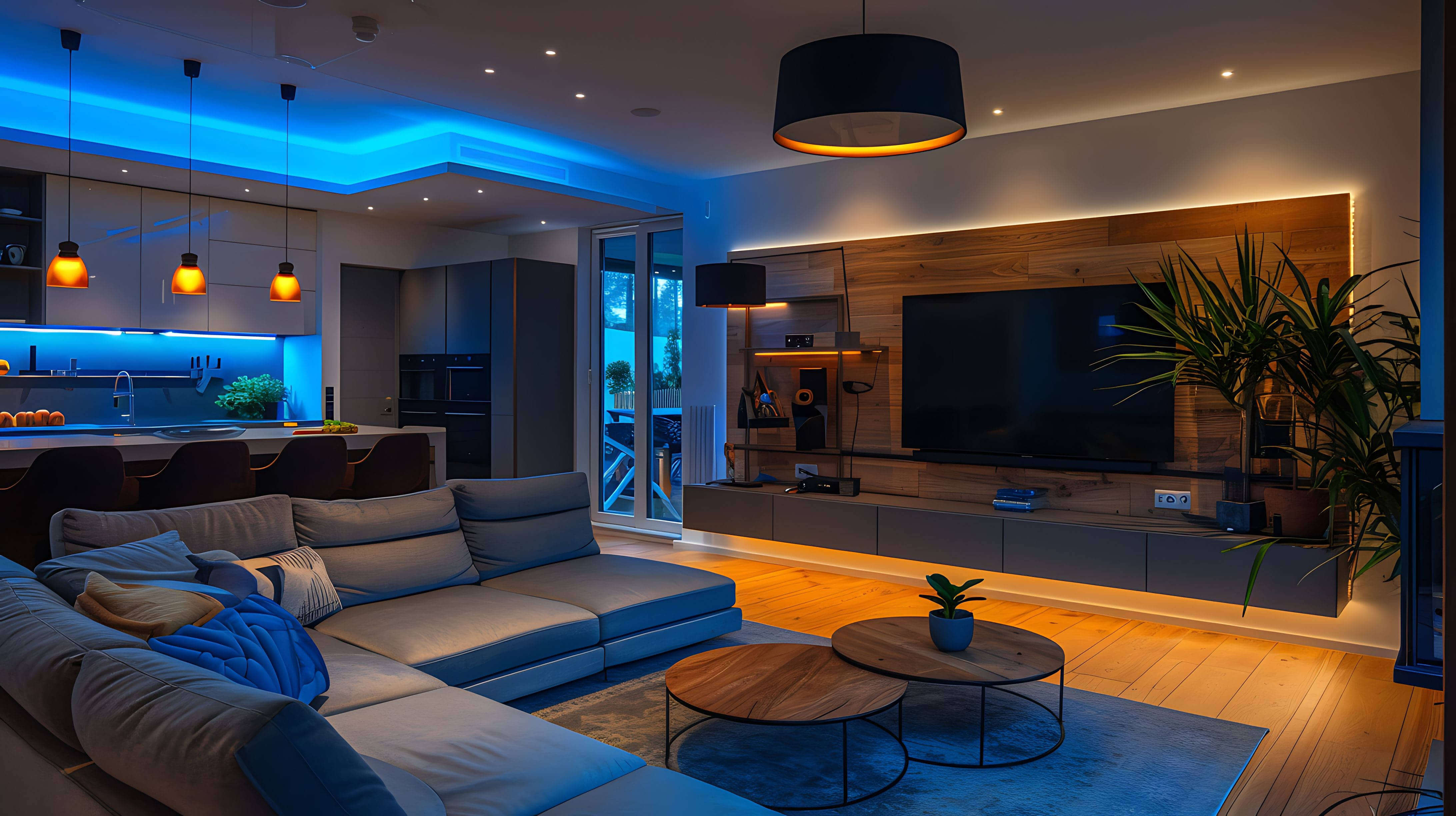
The best smart lighting automation system for an Indian home
depends primarily on scale and long-term goals: WiFi-based smart bulbs and
switches work well for renters and small budgets, while a KNX-based system is
the right choice for homeowners building or renovating who want scene-based
control, DALI-2 dimming quality, and integration with the rest of the home's
automation. There isn't a single "best" system for everyone, there's
a best system for a specific home and budget.
We design and install KNX-based lighting
automation systems across Delhi NCR, Noida, Gurgaon, and Jaipur. This guide
compares the main system options available in India in 2026, what each one
actually delivers, and how to decide which is right for your home.
What Are the Main Smart Lighting Automation Systems Available in India?
System Type |
How It Works |
Best For |
Approx. Starting Cost |
|
WiFi smart bulbs/switches |
Individual app-controlled bulbs or switch retrofits |
Renters, small budgets, single rooms |
₹1,500 per point |
|
Zigbee/hub-based systems |
Devices connected via a hub (Google Nest, Amazon Echo,
Aqara) |
Apartments wanting whole-home app control |
₹8,000–25,000 (hub) + per-device cost |
|
KNX scene-based system |
Dedicated wired bus, keypad and scene control |
New construction, renovations, premium homes |
₹2,50,000+ (full apartment) |
|
KNX + DALI-2 professional |
KNX bus with addressable, flicker-free dimming per fixture |
Luxury villas, architect-led interiors |
₹6,00,000+ (full apartment) |
Why is a KNX-Based System the Best Choice for Most New Construction and Renovation Projects?
For homeowners building a new home or doing a significant
renovation, a KNX-based lighting automation system is consistently the better
long-term choice over WiFi or hub-based alternatives, for three specific
reasons:
1. Reliability that doesn't depend on your WiFi
A KNX system operates on its own dedicated bus cable,
independent of your home's internet connection. Lighting scenes, schedules, and
dimming continue working even if your router goes down — something no
WiFi-based smart lighting system can claim, since they depend on a stable
wireless connection to function.
2. Genuine scene-based control, not just remote on/off
The difference between "smart lighting" and
"scene-controlled lighting" is significant. A WiFi smart bulb lets
you turn a light on or off from your phone. A KNX system lets you press one
keypad button and simultaneously dim the living room to 50%, switch the colour
temperature to warm, and trigger the same logic across every connected fixture
in the room — programmed once, triggered instantly, every time.
3. DALI-2 dimming quality
For homes that care about lighting quality — not just
convenience — DALI-2 integration (available through KNX) delivers smooth,
flicker-free dimming from 0.1% to 100%, individually addressable per fixture.
WiFi dimmers typically can't match this dimming smoothness, particularly at low
brightness levels.
When is a WiFi or Hub-Based System the Better Choice?
It's worth being honest about when KNX isn't the right
answer. WiFi-based smart lighting genuinely makes sense when:
- You're
renting and can't run new wiring or modify the electrical setup
- Your
budget is focused on a single room or a handful of points
- You
want to test smart lighting before committing to a larger system
- The
home isn't undergoing construction or major renovation, and retrofitting a
full KNX bus isn't practical
For these situations, a Google Nest, Amazon Echo, or
Aqara-based hubs with WiFi smart switches delivers genuinely useful remote
control and basic scheduling, at a fraction of the cost of a full KNX
installation.
How Do You Choose the Right System for Your Specific Home?
Three questions determine which system makes sense:
Is the home under construction or being renovated? If
yes, KNX is almost always the better long-term investment — the cost difference
is much smaller when wiring is planned from the start, compared to retrofitting
later. If the home is finished and you're not planning major work, a wireless
system avoids unnecessary disruption.
How many rooms need automation? A single room or two
can be reasonably served by WiFi smart switches. A full home — especially one
with 4+ bedrooms or distinct living/entertaining zones — benefits significantly
from the centralised scene logic that only a bus-based system like KNX delivers
cleanly.
Does lighting need to coordinate with other systems? If
you want lighting scenes tied to climate, curtains, and security — a
"Leave Home" scene that locks doors, adjusts AC, and turns off all
lights together — KNX is the only system architecture that does this natively
across all systems. WiFi ecosystems can approximate this through third-party
integrations like Matter, but the reliability and responsiveness rarely match a
properly programmed KNX system.
A Real Example: Choosing the Right System for a Sector 137 Noida Apartment
A homeowner in Sector 137, Noida initially considered WiFi
smart bulbs for their 3BHK apartment — a quick, low-cost way to get app
control. After discussing their actual goals with our team, it became clear
they wanted coordinated morning, evening, and away routines across the whole
apartment, not just individual bulb control from an app.
We moved the project to a KNX-based system instead — 18
lighting points across the apartment, four whole-home scenes, and a Basalte
keypad at the entrance. The system cost more upfront than the WiFi alternative
would have, but delivered something WiFi smart bulbs structurally couldn't: one
button that reliably executes the same coordinated lighting logic every single
time, regardless of internet connectivity.
What Does a Complete Smart Lighting Automation System Cost in India?
Home Size |
WiFi-Based System |
KNX Scene-Based System |
KNX + DALI-2 Professional |
|
2BHK Apartment |
₹25,000 – ₹70,000 |
₹2,50,000 – ₹5,00,000 |
₹4,00,000 – ₹7,00,000 |
|
3BHK Apartment |
₹40,000 – ₹1,20,000 |
₹4,00,000 – ₹8,00,000 |
₹6,00,000 – ₹12,00,000 |
|
4BHK Villa |
₹70,000 – ₹2,00,000 |
₹7,00,000 – ₹15,00,000 |
₹10,00,000 – ₹22,00,000 |
These figures cover lighting automation specifically and are
indicative estimates — actual cost depends on point count, brand selection
(keypad and driver), and whether the project is new construction or a retrofit.
For a detailed cost breakdown, see our lighting
automation cost guide.
FAQs
What is the best smart lighting automation system for a new home in India?
For new construction or major renovation, a KNX-based system
is generally the best long-term choice, since wiring can be planned from the
start and the cost premium over WiFi alternatives is comparatively small when
built into the project from day one.
Is WiFi smart lighting good enough, or do I need KNX?
It depends on your goals. WiFi smart lighting is genuinely
good enough for renters, small budgets, and single-room use. KNX is the better
choice when you want reliable scene-based control across a full home, dimming
quality that matches WiFi alternatives, or integration with climate, security,
and curtains.
Can I start with WiFi smart lighting and upgrade to KNX later?
Yes, though it's worth knowing that upgrading later
typically means re-wiring, since KNX requires a dedicated bus cable that WiFi
systems don't use. If there's any chance of upgrading to KNX in the future,
it's often more cost-effective to wire for KNX during initial construction even
if you start with simpler programming, rather than retrofitting later.
Which brands make the best smart lighting automation systems in India?
For KNX-based systems, keypad brand (Basalte, ABB, CORE)
affects design and durability, while the underlying KNX/DALI-2 logic performs
identically regardless of brand. For WiFi systems, Google Nest and Amazon Echo
ecosystems have the widest device compatibility in India currently.
Does a smart lighting automation system save money on electricity?
Yes, primarily through occupancy-based automation and
scheduled dimming — lights that turn off automatically in empty rooms and dim
appropriately rather than running at full brightness constantly. The savings
are more significant in larger homes with more lighting points, where manual
habits are harder to maintain consistently.
Ready to Choose the Right System for Your Home?
The best smart lighting automation system isn't the most expensive one or the cheapest one — it's the one that matches your home's construction stage, scale, and how deeply you want lighting integrated with the rest of your automation. Talk to our team for a free consultation on the right system for your specific home, or explore our premium switches and lighting services for more details.