

The Future of Smart Homes in India: Trends to Watch in 2026
Five years ago, smart home in India were seen as luxury upgrades — something “nice to have.” In 2026, that perception has shifted dramatically. Smart automation is no longer about showing technology; it is about experiencing comfort, intelligence, and seamless living.Today’s homeowner is not searching for gadgets. They are searching for a trusted smart home automation company in India that can design an ecosystem — not just install devices.
In the premium housing segment, the demand for luxury smart home solutions in India is accelerating, especially among villa owners who want technology that blends seamlessly into their architecture.
So what exactly is changing in 2026? Let’s take a closer look.
Smart Homes Are Becoming Predictive
Earlier, automation meant control.
Now, it means anticipation.
Instead of telling your home what to do, your home begins to understand your patterns.
Imagine returning from work every evening around 7 PM. Over time, the system becomes accustomed to this routine. The lights adjust automatically, the indoor temperature shifts to your preferred setting, and soft ambient music starts playing — without you touching a switch.
This is AI-driven automation.
It’s subtle.
It’s quiet.
But it changes the entire living experience.
That shift — from reactive to predictive — defines the future of home automation in India.
Integration Is the New Standard
One of the biggest frustrations homeowners faced earlier was managing multiple apps for lighting, security, audio, and climate.
In 2026, integration is non-negotiable.
Modern systems are built around unified ecosystems where lighting, AV, HVAC, and security communicate with each other. This level of coordination is particularly important in larger homes, where managing systems manually becomes inefficient.
When selecting a smart home automation company in India, integration capability is far more important than the number of devices offered.
Because the real luxury is simplicity.
Luxury Smart Home Solutions India: Technology That Disappears
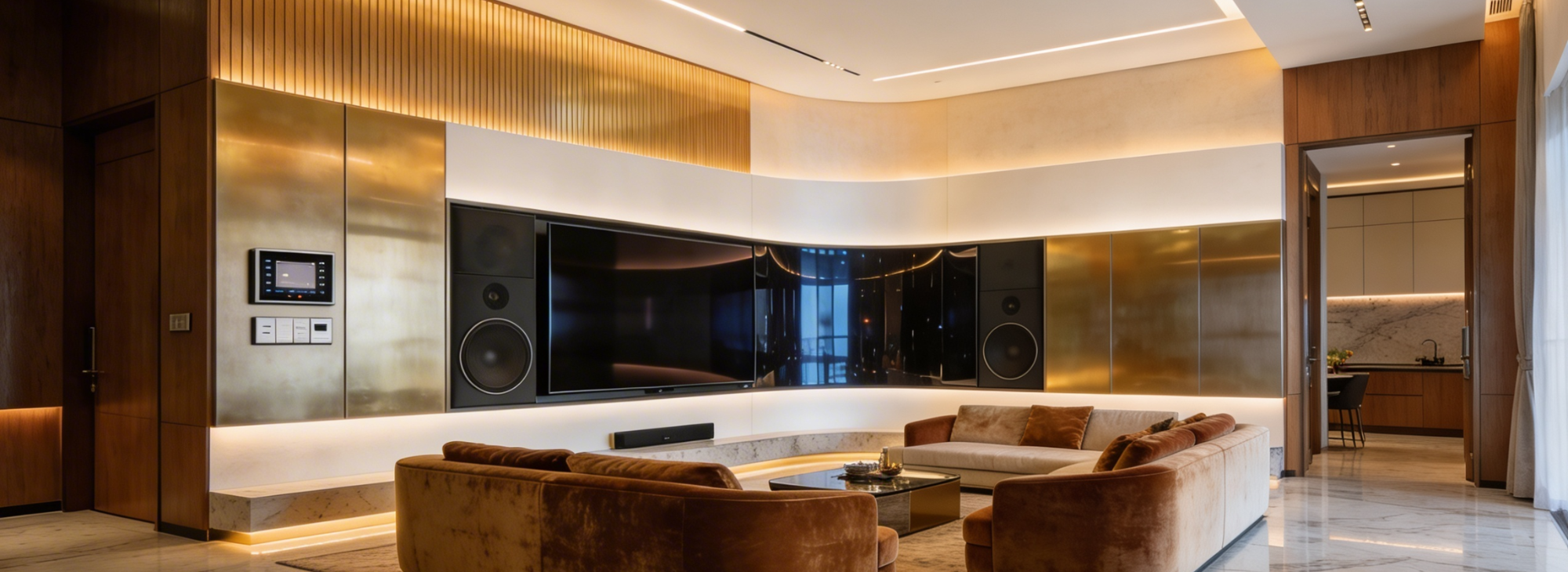
In high-end homes, technology should never dominate design. It should support it.
Lighting is a perfect example. Instead of visible fixtures and bulky panels, homeowners now prefer:
- Cove lighting integrated into ceilings
- LED strips concealed in architectural grooves
- Minimal touch panels
- Centralized control interfaces
- You see the effect — not the hardware.
That is what defines true luxury smart home solutions in India today.
Human-Centric Lighting Is Redefining Comfort
Wellness is no longer limited to gyms and spas. It has entered the home environment.
Human-centric lighting adjusts color temperature throughout the day to support natural circadian rhythms. Bright white tones in the morning encourage focus and alertness. Warmer tones in the evening promote relaxation and better sleep.
Many homeowners don’t realize how much lighting affects mood until they experience the difference firsthand.
This is not just automation. It is environmental design.
Why Home Automation is Growing Rapidly
Automation becomes even more essential in penthouse, Apartment, villas.
Managing a 5,000–10,000 sq. ft. property manually is simply inefficient. Landscape lighting, pool pumps, gate access, perimeter security, multi-floor climate control — all of it needs coordination.
That is why home automation for villas is seeing significant growth across metropolitan regions.
In such properties, reliability is critical. Wired systems are often preferred because they offer long-term stability and minimal interference. More importantly, automation is integrated during the construction phase rather than added later.
Villa owners are not looking for basic convenience. They are investing in infrastructure.
Entertainment Has Become Architectural
The modern home theatre is no longer a separate room filled with visible equipment.
In 2026, entertainment systems are designed to blend into interiors:
- In-ceiling speakers
- Hidden subwoofers
- Seamless LED display panels
- Whole-home synchronized audio
Music can follow you from the living room to the terrace without disruption. Visual displays now use advanced technologies that eliminate pixel gaps and enhance clarity.
It is immersive — yet discreet.
That balance defines premium AV integration.
Security Is Moving From Monitoring to Prevention
Security expectations have also evolved.
Modern surveillance systems now use intelligent analytics to distinguish between routine movement and unusual activity. This reduces false alerts while increasing situational awareness.
Additionally, cybersecurity has become equally important. As locks and cameras connect to networks, encryption and secure architecture are critical.
A reputable provider of luxury smart home solutions in India must address both physical and digital safety.
Because a connected home must also be a protected home.
Sustainability Is No Longer Optional
Energy efficiency is a growing priority among Indian homeowners.
Smart automation can:
- Monitor electricity usage in real time
- Optimize air conditioning cycles
- Integrate with solar systems
- Automate irrigation based on weather data
- Beyond comfort, automation contributes to responsible living.
Luxury today is defined not just by aesthetics, but by intelligence and efficiency.
Cost and Value Perspective
One of the most common questions remains: What is the investment required?
While costs vary depending on size and complexity, fully integrated villa systems represent a long-term infrastructure investment rather than an expense.
More importantly, automation enhances:
- Property value
- Operational efficiency
- Lifestyle convenience
- Long-term scalability
Selecting the right smart home automation company in India ensures that the system remains adaptable for years to come.
Final Thoughts: Intelligent Living Is the Future
The future of smart homes in India isn’t about adding more gadgets — it’s about creating intelligent spaces that naturally adapt to the people living in them. From predictive AI and invisible lighting to integrated entertainment and proactive security, modern home automation for villas and premium residences is redefining architecture.
The question is no longer whether smart homes are worth it — it’s how intelligently you want to live in 2026. When designed properly, a smart home doesn’t feel complex or technical. It simply feels seamless and effortless.