

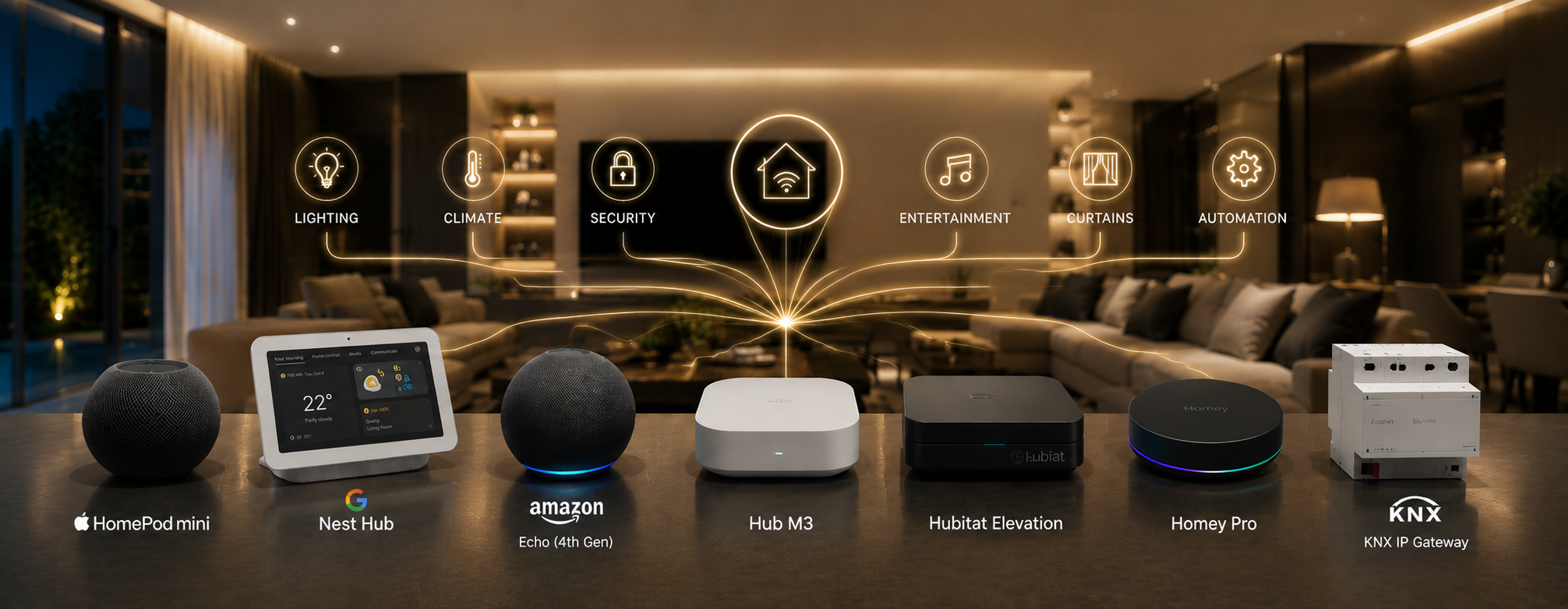
Imagine this.
You're on your way home after a long day. Before you even
step inside, the lights soften, the AC cools the room to your preferred
temperature, the curtains gently close, and your favourite music begins to
play.
Now imagine doing all of this by opening three different
apps. That doesn't feel very smart, does it? A truly smart home isn't about
collecting devices. It's about creating harmony between them.
This is where smart home hubs come in. They don't just
connect gadgets — they give your home a brain. A central intelligence that
ensures everything works together smoothly, quietly, and intelligently.
Your home stops waiting for commands. It starts responding
to your lifestyle.
What is a Smart Home Hub?
In simple words, a smart home hub is the control centre of
your home.
If your smart lights speak one language and your smart lock
speaks another, the hub acts like a translator. It ensures every device
understands when to act, how to act, and why.
Without a hub, your devices work individually. With a hub,
they work as a team — and that makes all the difference.
A smart home hub connects to your home automation system and
acts as the single point of control for lighting, climate, security, and
entertainment — all from one app, one keypad, or one voice command.
Best Smart Home Hubs India 2026 — Top Picks Compared
Before choosing a hub, understand what each option is
designed for. The best smart home hub for a 2BHK apartment in Noida is very
different from the right choice for a 6,000 sq ft villa in Greater Kailash.
Hub |
Best For |
India Price |
Protocol Support |
Internet Dependency |
|
KNX IP Gateway |
Luxury villas, large homes |
₹25,000–60,000 |
KNX, Matter bridge |
None — works offline |
|
Google Nest Hub |
Apartments, Google users |
₹8,000–15,000 |
WiFi, Zigbee, Matter |
Required |
|
Amazon Echo (4th Gen) |
Voice-first setups |
₹5,000–12,000 |
WiFi, Zigbee, Matter |
Required |
|
Apple HomePod Mini |
iOS / Apple ecosystem |
₹10,000–12,000 |
WiFi, Thread, Matter |
Required |
|
Control4 EA-1 |
Large homes, multi-system |
₹80,000–1,50,000 |
Multi-protocol |
Optional (local) |
|
Hubitat Elevation |
Advanced DIY, local control |
₹15,000–20,000 |
Zigbee, Z-Wave, WiFi |
None — fully local |
|
Aqara Hub M3 |
Multi-brand local control |
₹6,000–10,000 |
Zigbee, Matter, Thread |
Optional |
|
Homey Pro |
Advanced multi-protocol DIY |
₹18,000–25,000 |
Zigbee, Z-Wave, Matter, IR |
None — local |
Our recommendation for Indian homes:
- 1–3BHK
apartments → Google Nest Hub or Amazon Echo
- Independent
houses (3,000–5,000 sq ft) → Control4 or Hubitat Elevation
- Luxury
villas and farmhouses → KNX IP Gateway with professional integration
Best Smart Home Hub for Apple Ecosystem: Apple HomePod Mini
For households heavily reliant on iPhones, iPads, and macOS
devices, the Apple HomePod Mini is the natural choice. It serves as the anchor
for Apple HomeKit, supports Thread technology for a wide array of compatible
smart home devices, and integrates Siri for hands-free voice control.
Price in India: ₹10,000–12,000 Best for:
iOS/Apple ecosystem homes, 1–3BHK apartments Protocol: WiFi, Thread,
Matter Internet: Required for full functionality
Best Smart Home Hub for Google/Android Users: Google Nest Hub
Android and Google users will find the Google Nest Hub (2nd
Gen) the most seamless choice. It has a built-in display for visual control of
connected devices, supports Google Assistant for voice commands, and works with
a broad range of smart home brands through Matter and Zigbee.
Price in India: ₹8,000–15,000 Best for: 1–3BHK
apartments, Google Assistant users Protocol: WiFi, Zigbee, Matter Internet:
Required
Best Smart Home Hub for Voice-First Homes: Amazon Echo (4th Gen)
For homes where voice control is the primary interface,
Amazon Echo (4th Gen) leads. Alexa's skill ecosystem is the largest of any
voice assistant, and the Echo supports Zigbee natively, allowing direct pairing
of compatible devices without additional bridges.
Price in India: ₹5,000–12,000 Best for:
Voice-first setups, budget-conscious homes Protocol: WiFi, Zigbee,
Matter Internet: Required
Best Smart Home Hub for Multi-Brand Local Control: Aqara Hub M3
For homeowners who want local control without cloud
dependency and need to connect devices across multiple brands, the Aqara Hub M3
is one of the best value options in 2026. It supports Matter, Thread, and
Zigbee, works locally without internet for core functions, and is Matter
controller certified — making it future-proof for new device purchases.
Price in India: ₹6,000–10,000 Best for:
Multi-brand setups, local control priority Protocol: Zigbee, Matter,
Thread Internet: Optional — local control available offline
Best Smart Home Hub for Advanced DIY and Multi-Protocol: Homey Pro
Homey Pro is built for homeowners who want maximum protocol
flexibility and full local control. It supports Zigbee, Z-Wave, Matter,
Bluetooth, IR, and 433 MHz — covering virtually every smart home protocol in
use in India today — and runs entirely locally without any cloud subscription.
Price in India: ₹18,000–25,000 Best for:
Advanced DIY users, multi-protocol homes Protocol: Zigbee, Z-Wave,
Matter, IR, 433 MHz Internet: None — fully local
Best Smart Home Hub for Luxury Villas India: KNX IP Gateway
For luxury villas, large independent houses, and premium
apartments where long-term reliability, integration depth, and professional
control are the priority, the KNX IP Gateway is in a different category from
consumer smart home hubs.
KNX is not just another smart product — it is a globally
trusted wired home automation
standard (ISO/IEC 14543-3 certified) used in high-end residential and
commercial projects across 90+ countries. A KNX IP Gateway bridges the home's
KNX bus to app, voice assistant, and remote access — while the core system
(lighting, climate, security, curtains) continues to operate locally without
any internet dependency.
Price in India: ₹25,000–60,000 (gateway only; full
KNX system quoted separately). Best for: Luxury villas, large homes
(4BHK+), farmhouses. Protocol: KNX, Matter bridge Internet: None
required for core functions
At Techvault, every KNX project includes professional ETS6
programming, scene design, and handover of the complete project file — so the
system remains serviceable and expandable for decades, not just years. Explore
our premium
switches and lighting, and lighting automation
services for more on KNX-integrated smart home design.
Key Benefits of Smart Home Hubs
1. One Dashboard. Total Control.
No more juggling multiple apps for different brands.
Lighting, security, climate, and entertainment — all managed from one place.
Simple. Clean. Efficient.
2. Real Automation — Not Just Remote Control
True intelligence begins with routines. For example: if
motion is detected outside → outdoor lights turn on → you receive an alert →
indoor lights switch to night mode.
In our projects across Delhi NCR and Noida, homeowners
consistently report that scene-based automation — not remote control — is what
transforms daily life.
3. Future-Ready with Matter and Modern Protocols
Technology changes fast. The best smart home hubs in 2026
support Matter, Zigbee, and Thread — ensuring the system you invest in today
continues working with tomorrow's devices. Matter is a universal smart home
standard supported by Apple, Google, Amazon, and Samsung, meaning devices from
different brands finally speak the same language.
Consumer Hubs vs KNX — The Full Comparison
Feature |
Consumer Smart Hubs |
KNX + Smart Hub Integration |
|
Best For |
Apartments and DIY setups |
Large villas and luxury homes |
|
Installation |
Plug and play (wireless) |
Professional TP bus wiring |
|
Reliability |
Depends on the WiFi signal |
Fully stable, hardwired |
|
Internet Dependency |
Required for most features |
None — works fully offline |
|
Programming |
App-based, limited logic |
ETS6 — full scene logic |
|
Lifespan |
3–5 years typical |
25–30+ years |
|
Investment |
Affordable |
Premium, long-term |
|
ETS Project File |
Not applicable |
Handed over to the client |
Wireless systems are convenient. KNX systems are dependable.
In large homes, WiFi signals can weaken, devices can disconnect, and
performance can fluctuate. KNX, being hardwired, offers unmatched stability and
scalability. It's not just smart — it's engineered.
Smart Home Hub + Lighting + AV — Scene Integration
The real power of a smart home hub is scene integration —
one button that activates multiple systems simultaneously.
Scene |
Lighting |
AV |
Climate |
Security |
|
Good Morning |
60% warm white |
Radio in the kitchen |
AC to 23°C |
Disarmed |
|
Movie Night |
5% amber |
Projector + Atmos |
22°C |
— |
|
Leave Home |
All off |
All off |
Off |
Armed |
|
Good Night |
5% nightlights |
Off |
25°C sleep |
Armed |
In our recent project in a Noida Sector 50 villa, we
integrated a KNX IP gateway with Basalte keypads, a Dolby Atmos home cinema,
and motorised
blinds. This single "Evening" button activates all four systems
in under 2 seconds.
Do You Need a Professional AV Integrator for Your Smart Hub?
For basic apartment setups — Google Nest or Amazon Echo —
DIY installation works fine.
For whole-home integration involving KNX lighting
automation, wireless alarm systems, multi-room audio, and
motorised curtains, professional integration is not optional. It is the
difference between a system that performs for 20 years and one that frustrates
within 20 months.
At Techvault, we have completed 200+ smart home projects
across Delhi NCR, Noida, Gurgaon, Jaipur, and Chandigarh — from basic apartment
automation to complete KNX villa installations with Basalte keypads and Dolby
Atmos cinema rooms.
Conclusion
Building a smart home is not about trends. It's about
comfort, reliability, and simplicity. Choosing the right smart home hub is the
first and most important step in creating a connected living experience. For
smaller homes, a wireless hub may be enough. For larger homes and luxury
spaces, integrating KNX with a smart hub ensures performance that lasts for
decades.
Because in the end, a smart home is not about devices. It's
about integration — and every intelligent home deserves a brain that is equal
to its ambition.
Talk to our team for a free consultation on the right hub and automation setup for your home.
FAQs
What does a smart home hub do?
A smart home hub connects all your smart devices and makes
them work together. Instead of using multiple apps, you control lights, AC,
security, and more from one system. It acts as the brain of your home, enabling
automation and seamless control.
What is the best hub for a smart home in India?
The best hub depends on your home and devices. Apple users
may prefer HomePod Mini, while Google users may choose Nest Hub. For
brand-agnostic local control, Aqara Hub M3 or Homey Pro are strong options. For
luxury villas and large homes, a KNX IP Gateway with professional integration
offers better stability and long-term reliability than any consumer hub.
What is meant by a smart home hub?
A smart home hub is a central device that connects and
controls different smart products in your home. It allows them to communicate
with each other and run automations, so your home works as one connected system
rather than a collection of separate apps.
Can a smart home work without the internet?
Yes. KNX-based systems and hubs like Hubitat Elevation,
Aqara Hub M3, and Homey Pro work fully locally without internet for core
functions. Consumer hubs like Google Nest and Amazon Echo require internet for
most features, though some basic local functions may still work during an
outage.
What is the KNX protocol for smart homes?
KNX is a professional wired automation system used in homes
and buildings worldwide. Certified under ISO/IEC 14543-3, it connects lighting,
climate, and security through a stable bus cable, offering reliable and
long-term performance — ideal for large or luxury homes where WiFi-dependent
systems are not sufficient.
Which smart home hub works without WiFi in India?
For fully offline local control, Hubitat Elevation, Homey Pro, and Aqara Hub M3 all offer local processing without cloud dependency. For professional installations, a KNX IP Gateway operates the entire home automation system — lighting, climate, security, curtains — without any WiFi or internet requirement for core functions.