

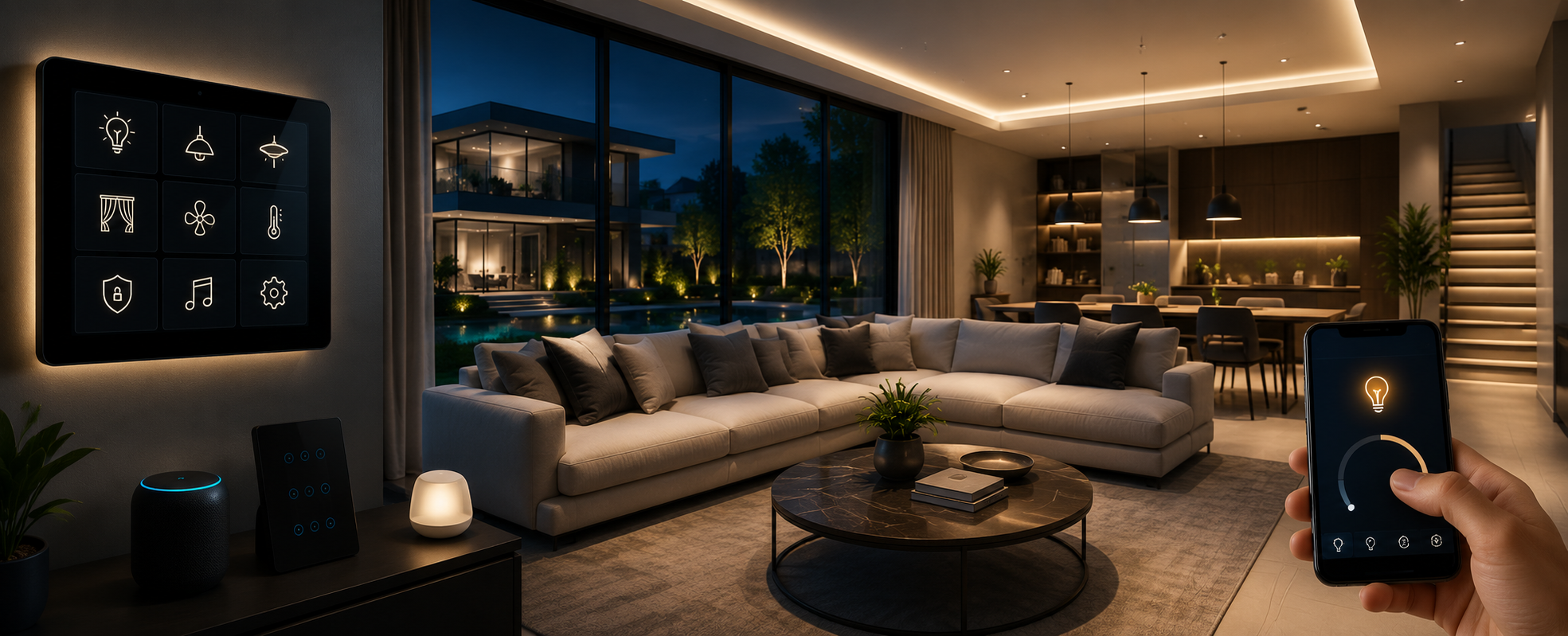
Home lighting automation is the use of KNX actuators, DALI dimmers, occupancy sensors, and scene controllers to automatically manage every light in your home — replacing manual switches with pre-programmed scenes, schedules, and sensor-triggered responses that adjust lighting based on time of day, occupancy, and activity, reducing electricity consumption by 20–35%.
Think about the last time you walked into a dark room and
fumbled for a switch. Or the last time you went to bed and spent five minutes
wondering whether you switched off the kitchen light. Or the electricity bill
that arrived after a month of lights accidentally left on in rooms nobody was
using.
Home lighting automation solves all three, not as a
novelty, but as a practical, daily-use system that most homeowners in our Delhi
NCR and Jaipur projects describe as the single most impactful change in their
home.
This guide covers what lighting automation actually is, how
it works technically, what to look for before installing, and the honest cost
of doing it properly in an Indian home.
What is Home Lighting Automation?
Home lighting automation uses smart switches, DALI
dimmers, occupancy sensors, and a KNX controller to manage every light circuit
in your home, individually, in groups, or as complete scenes, automatically
or from a single app or keypad.
It is not the same as replacing your bulbs with smart bulbs.
A smart bulb on a Wi-Fi app is a connected device. A lighting automation system
is an integrated platform where every light responds to the same logic, scenes, and schedules, coordinated by a central controller.
The difference matters practically. With smart bulbs, you
have 15 different lights and potentially 15 different app entries to manage.
With a KNX-DALI lighting system, you press one button marked
"Evening" and the entire home transitions, the living room drops to 40%
warm white, the kitchen to 60% cool white, the corridor to 10% amber, and the bedroom off. One
action, everything configured correctly.
Why Does Home Lighting Automation Matter?
Energy Savings — The Most Measurable Benefit
DALI lighting control system with occupancy sensors reduces
electricity consumption by 20–35% in Indian homes. The mechanism is
straightforward — lights are only on when the room is occupied, only at the
brightness level the activity requires, and automatically off when no longer
needed.
In a typical 4BHK villa in Noida, we measured an average of
3.2 hours per day of lights left on in unoccupied rooms before automation.
After occupancy-sensor installation, this dropped to under 12 minutes. At Rs. 8
per unit, the annual saving on lighting alone was Rs. 18,000–24,000.
Ambience — Lighting That Matches How You Actually Live
Scene |
Lights |
Colour Temp |
Best For |
|
Morning |
60% gradual |
5,000K cool white |
Wake-up, alertness |
|
Work / Study |
80% |
4,000K neutral |
Focus, screen work |
|
Evening |
40% |
2,700K warm white |
Relaxed family time |
|
Dining |
Pendant 100%, ambient 30% |
2,700K |
Dinner, entertaining |
|
Cinema |
5% floor only |
2,200K warm amber |
Movie watching |
|
Good Night |
5% corridor |
2,200K |
Safe movement at night |
|
Away / Security |
Scheduled random |
Mixed |
Simulate occupancy |
Security — Lighting as a Deterrent
Scheduled lighting when you are away — lights turning on and
off in different rooms at realistic times — is one of the most effective
low-cost security measures available. A home that looks occupied is
significantly less attractive to opportunistic thieves. KNX lighting systems can
randomise this schedule automatically, making the pattern unpredictable.
How Does an Automated Lighting System Work?
A professional home lighting automation system has three
layers:
Layer 1 — The Devices
DALI LED drivers replace standard LED drivers inside
your light fittings. Each driver has its own DALI address — meaning it can be
individually controlled, dimmed to any level between 0.1% and 100%, and
monitored for faults.
KNX switching and dimmer actuators are installed in the
electrical panel control circuits that do not use DALI — external lights,
feature lighting, and garden circuits.
Occupancy sensors (PIR or radar) detect presence in
each room and trigger lighting automatically.
Daylight sensors measure ambient light levels and
reduce artificial lighting when natural light is sufficient — a function called
daylight harvesting.
Keypads — from brands like Basalte, ABB, or Core —
are the physical interface. One keypad button per room activates the relevant
scene.
Layer 2 — The Protocol
All devices communicate over the KNX TP bus — a
2-wire cable that runs to every switch position in the home. KNX operates at
29V DC, independent of the internet, WiFi, and mains power fluctuations. When you
press a Basalte keypad in a KNX home, the light responds in 10–50 milliseconds
— before your finger leaves the button.
Layer 3 — The Programming
All logic — which sensor triggers which light, which button
activates which scene, what happens at sunset — is programmed in ETS6,
the official KNX Association software. This is where the intelligence lives,
and this is where the quality of your integrator is most visible. A
well-programmed KNX system anticipates how you live. A poorly programmed one
requires constant manual adjustment.
Wired vs Wireless — Which Is Right for Your Home?
KNX Wired (TP) |
KNX RF (Wireless) |
WiFi Smart Switches |
|
|
Best for |
New construction, full renovation |
Retrofit, existing home |
Basic apartment, rental |
|
Internet dependency |
None |
None |
Required |
|
Response time |
10–50ms |
50–200ms |
500ms–2 seconds |
|
Reliability |
Highest |
High |
Variable |
|
Lifespan |
25–30 years |
25–30 years |
3–5 years |
|
Scalability |
Unlimited |
Good |
Limited |
|
Installation |
During construction |
Any time |
Any time |
|
Cost |
Premium |
Mid-premium |
Budget |
Our recommendation for Indian homes:
New construction or renovation underway — always KNX wired.
This is the right time to pull the cable, and the cost is far lower than
retrofitting later.
Existing home, walls plastered — KNX RF. Professional-grade
performance without cable pulling. Works seamlessly with KNX TP in hybrid
installations.
Rental flat or very limited budget — WiFi smart switches for
basic control. Understand that they are a short-term solution.
5 Things to Check Before Installing Lighting Automation
1. Is the electrician or company KNX certified?
DALI and KNX installation require certified training. An
uncertified electrician can connect the hardware, but cannot program it
correctly. Always ask for the KNX Association certificate number and verify at
knx.org.
2. Will you receive the ETS6 project file?
This file contains the complete programming of your lighting
system. Without it, you cannot make changes, expand the system, or use a
different integrator in future. Professional integrators provide it at handover
— no exceptions.
3. Is the scope documented before work begins?
A lighting automation proposal should specify — by room —
which circuits are automated, which fixtures use DALI drivers, where occupancy
sensors are placed, and what scenes are programmed. Vague proposals lead to
vague results.
4. What happens during a power cut?
KNX systems should have a UPS on the bus power supply. When
power is restored, devices should return to a defined state — not random. This
behaviour is configured in ETS6 and is a good indicator of programming quality.
5. Can lighting integrate with the rest of your home?
A lighting system that cannot communicate with your security, AV, or climate system is a missed opportunity. KNX lighting integrates natively with KNX security, climate, and AV — one "Leave Home" button turns off lights, arms the alarm, and switches off the AC simultaneously.
What Does Home Lighting Automation Cost in India?
Scope |
What's Included |
Investment Range |
|
Basic — 2BHK apartment |
WiFi smart switches, 2 scenes, app control |
₹35,000–65,000 |
|
Mid — 3BHK with DALI |
KNX dimmer + DALI drivers + 4 scenes + keypads |
₹1.2–2.5 lakh |
|
Complete — 4BHK villa |
Full KNX + DALI + occupancy sensors + 8 scenes |
₹2.5–6 lakh |
|
Luxury — large villa |
Basalte keypads + RGB + landscape + 12+ scenes |
₹6–18 lakh |
These costs cover supply, installation, ETS6 programming,
commissioning, and one year of support. The ETS6 project file is included at
handover.
FAQs
What is home lighting automation in India?
Home lighting automation uses KNX actuators, DALI dimmers,
occupancy sensors, and scene controllers to manage every light in your home
automatically — reducing electricity consumption by 20–35% and replacing manual
switches with pre-programmed scenes that adjust based on time, occupancy, and
activity.
What is the difference between smart bulbs and lighting automation?
Smart bulbs are individual connected devices — each managed
separately. A lighting automation system is an integrated platform where every
light responds to unified scenes, schedules, and sensor triggers from one
controller. Smart bulbs are a starting point; lighting automation is a complete
system.
How much does home lighting automation cost in India?
Basic lighting automation for a 2BHK apartment starts at Rs. 35,000. A complete KNX-DALI system for a 4BHK villa with occupancy sensors,
DALI dimming, and 8 scenes costs Rs. 2.5–6 lakh. Luxury installations with
Basalte keypads range from Rs. 6–18 lakh.
Can lighting automation work during power cuts in India?
Yes — with a UPS on the KNX bus power supply. The KNX TP bus
operates at 29V DC and continues functioning during power cuts when backed by a UPS. Device state and scene memory are retained, and the system returns to a
defined state when power is restored.
Does Techvault install home lighting automation in India?
Yes. Techvault installs complete KNX and DALI lighting
automation systems across Delhi NCR, Noida, Gurgaon, Jaipur, and 26+ cities.
Every installation includes ETS6 project file handover. Contact our team for a
free lighting automation assessment.