

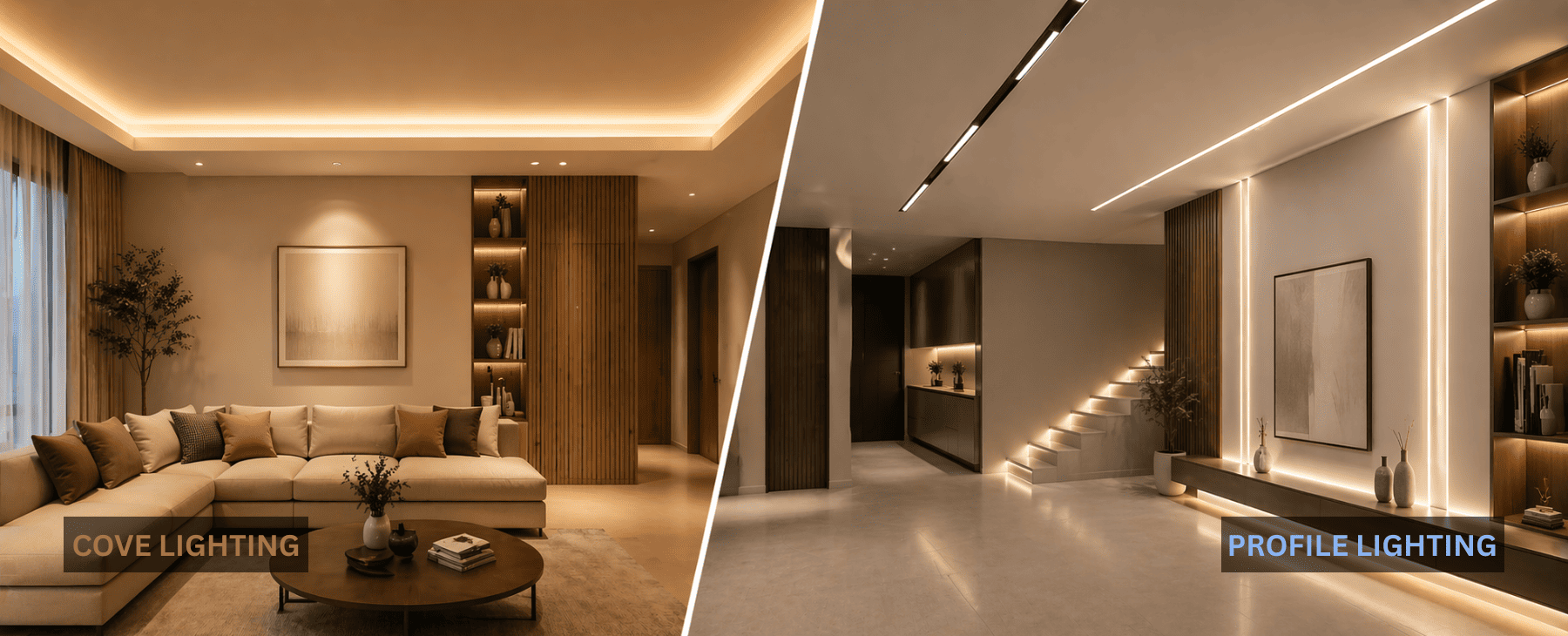
Confused between cove light and profile light for your smart home? You're not alone. Both are popular LED lighting options in modern Indian homes — but they serve very different purposes. In this complete guide, we break down everything you need to know: design, functionality, cost, and which one suits your space best.
What is Cove Lighting?
Cove lighting is an indirect lighting technique where LED strips are installed inside a ceiling recess, ledge, or cornice. The light bounces off the ceiling or wall, creating a soft, diffused, ambient glow — with no direct glare visible.
Cove lights are ideal for living rooms, bedrooms, and hospitality spaces where you want to create a warm, relaxed atmosphere. They are hidden from view, giving ceilings a floating, layered look that is very popular in modern interior design across Noida, Delhi NCR, and other Indian cities.
Key Definition: Cove lighting is an indirect LED lighting method in which the light source is hidden inside a ceiling pocket or ledge, and light reflects off the surface to fill the room with soft, even illumination.
What is Profile Lighting?
Profile lighting (also called LED profile channels or linear lights) uses aluminium extrusion profiles that house LED strips. These profiles come with diffuser covers (clear or frosted) that make the light source visible but controlled. Unlike cove lights, profile lights are directional — they push light downward, sideways, or in a focused beam. They are used for task lighting, accent lighting, under-cabinet lighting, shelf lighting, and staircase lighting. Profile lights provide clean, linear illumination and can be surface-mounted, recessed, or suspended — making them one of the most versatile lighting products available for modern smart homes.
| People also read |
Cove Light vs Profile Light — Key Differences
Here is a detailed comparison of cove lights and profile lights across the most important parameters:| Feature | Cove Light | Profile Light |
| Light Type | Indirect, ambient | Direct, focused |
| Visibility | Completely hidden | Visible (with diffuser) |
| Installation | Inside ceiling recess/ledge | Surface, recessed, or suspended |
| Glare | Zero glare | Minimal (with frosted diffuser) |
| Mood Effect | Very high — warm and cozy | Moderate — clean and modern |
| Best For | Living rooms, bedrooms, hotels | Kitchens, shelves, staircases |
| Smart Control | Fully compatible (dimming, RGB) | Fully compatible (dimming, CCT) |
| Cost | Higher (carpentry required) | Moderate (no major civil work) |
| Maintenance | Difficult (hidden inside the ceiling) | Easy (accessible profile) |
Pros and Cons of Each
Cove Light — Pros
- Zero visible glare — completely indirect illumination
- Creates a luxury, hotel-like ambience in any room
- Works beautifully with smart dimmers and colour tuning
- Excellent for mood and scene-based lighting control
- Hides all wiring and components completely inside the ceiling
Cove Light — Cons
- Requires false ceiling or carpentry work — higher installation cost
- Difficult to replace LED strips after the ceiling is closed
- Not sufficient as the only lighting source in a room
- Planning must happen during the construction or renovation phase
Profile Light — Pros
- Easy to install on any surface — wall, ceiling, shelf, or step
- Provides precise, directional lighting for tasks and accents
- LED strips are easily accessible and replaceable
- Multiple mounting options: surface, recessed, suspended, corner
- No major civil work required — can be retrofitted anytime
Profile Light — Cons
- Profile channel is visible — aesthetic trade-off in some designs
- Can look industrial if not installed carefully
- Not suitable as the sole source of ambient room lighting
Best Use Cases by Room
- Living Room
Use cove lights along the ceiling perimeter for ambient base lighting. Combine with profile lights on the TV unit, shelves, or behind the sofa for accent layers. When controlled with a smart automation system, you can create different scenes — Movie Mode, Party Mode, Relax Mode — with a single tap.
- Bedroom
Cove lighting at 2700K-3000K warm white is perfect for bedrooms. The indirect, glare-free light creates a peaceful, relaxing environment ideal for winding down. Add profile lights inside wardrobes or under the bed frame for a premium hotel-inspired finish.
- Modular Kitchen
Profile lights mounted under wall cabinets are the most practical choice for kitchen task lighting. They illuminate the counter surface directly, making cooking easier and safer. Use warm white (3000K) for a cozy feel or neutral white (4000K) for a clinical, functional look.
- Staircase
Profile lights along stair risers or handrails add a stunning visual effect while improving safety. This is one of the most popular smart lighting installations in Noida and Delhi NCR luxury apartments.
- Home Theatre
Cove lights with RGB or RGBW LED strips are ideal for home theatres. You can change the backlight colour to match the mood of the movie — deep red for action, soft blue for relaxing scenes — all controlled via your smart home app.
- Office & Boardroom
Profile lights with neutral white (4000K) or cool white (5000K-6500K) are preferred in work environments. They provide even, focused light that reduces eye strain and improves concentration.
Which One Should You Choose?
The best smart homes in Noida and Delhi NCR use both cove and profile lights together as part of a layered lighting design. Here is a quick verdict guide:
| Category | Winner |
| Best for mood & ambience | Cove Light |
| Best for task & accent lighting | Profile Light |
| Best for smart home integration | Both work equally |
| Best for low-cost installation | Profile Light |
| Best for luxury interiors | Cove Light |
| Best overall combination | Use Both Together |
If you have to choose only one, pick cove lights for ambience-heavy rooms like bedrooms and living rooms, and profile lights for task-critical areas like kitchens, study rooms, and staircases.
Pro Tip: When integrated with a smart home automation system (KNX, Lutron, or Control4), both cove and profile lights can be dimmed, colour-tuned, scheduled, and controlled via voice or app — giving you complete control over the mood and function of every room.
FAQ's
Q1. Can cove lights be controlled with voice or an app?
Yes. When integrated with a smart home automation system like KNX, cove lights can be dimmed, colour-tuned, or scheduled via voice commands (Alexa, Google Home) or a mobile app. Techvault specialises in this kind of seamless smart lighting integration across Noida, Delhi, and 50+ cities.
Q2. What LED strip is best for cove lighting?
For cove lighting, 24V COB LED strips are the most popular choice. They offer dot-free, smooth illumination and come in warm (2700K-3000K) and cool (4000K-6500K) variants. A frosted diffuser inside the cove ensures even light spread without any hotspots.
Q3. Is profile lighting expensive?
Profile lighting is generally more affordable than cove lighting because it does not require false ceiling construction. Aluminium profiles with LED strips typically start from Rs 150-400 per foot, depending on quality and brand. Installation is also quicker and simpler.
Q4. Which is better for the bedroom — cove or profile light?
Cove light is better for bedrooms. The indirect, glare-free illumination at 2700K-3000K creates a relaxed, cozy environment ideal for sleeping and unwinding. Pairing it with a smart dimmer gives complete control over brightness from 100% to a soft 10%-night mode.
Q5. Can I install cove and profile lights in the same room?
Absolutely — and this is the recommended approach for modern smart homes. Cove lights handle the ambient layer, while profile lights add task and accent layers. Together, they create a layered lighting design that is both functional and aesthetically stunning.
Q6. Are cove lights and profile lights energy efficient?
Yes. Both use LED technology, which consumes significantly less energy than traditional lighting. Smart controls such as dimming and scheduling further reduce electricity consumption. LED cove strips typically run on 12V or 24V DC with low wattage per metre.