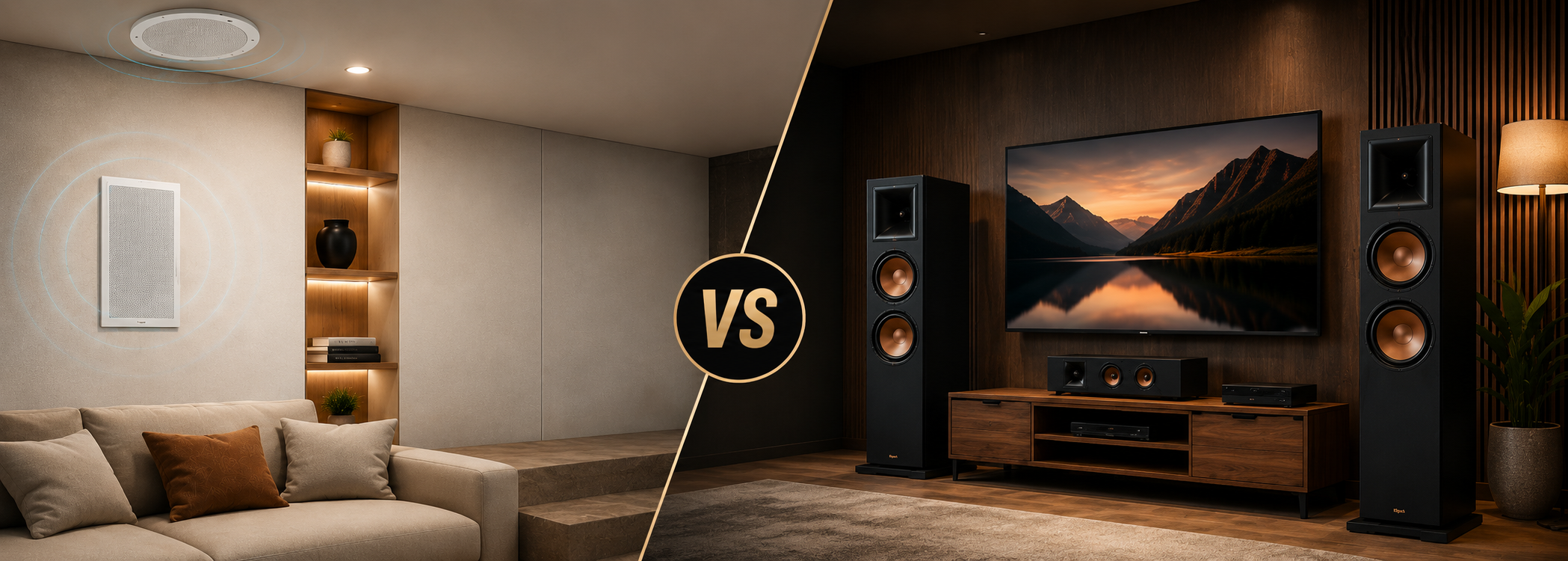
Architectural speakers are in-wall or in-ceiling units
installed flush into your home's structure, while traditional tower speakers
are freestanding floor units. For Indian living rooms, the right choice depends
on room size, interior design priorities, listening habits, and whether you
want pure audio performance or seamless aesthetics — both deliver excellent
sound when installed correctly.
This is one of the most common questions our team hears
during home AV consultations in Delhi, Noida, and Gurgaon. Homeowners are
choosing between two genuinely different philosophies — speakers you see and
speakers you do not — and both have strong arguments.
This guide gives you an honest comparison based on hundreds
of Audio-Visual installations we have completed across luxury homes,
apartments, and villas in India.
What Are Architectural Speakers?
In-Wall and In-Ceiling Speakers — How They Work
Architectural speakers — also called in-wall speakers or in-ceiling speakers — are installed directly into your home's structure. The driver assembly sits inside the wall or ceiling cavity, with only a slim grille visible on the surface. That grille can be painted to match your wall colour, making the speaker virtually invisible.
The term "architectural" comes from the fact that these speakers are designed to become part of the architecture, not sit on top of it. Brands like TruAudio, Klipsch, Polk Audio, Sonance, and Bowers & Wilkins produce architectural speakers specifically engineered for in-wall and in-ceiling installation.
Key technical components:
- Tweeter — handles high frequencies (2kHz–20kHz), typically 1-inch silk dome
- Woofer — handles mid and low frequencies (40Hz–2kHz), typically 6.5-inch to 8-inch
- Crossover network — splits the signal between the tweeter and woofer
- Back-box enclosure — isolates the driver from the wall cavity, dramatically improving bass response
What are Traditional Tower Speakers?
Floor-Standing Speakers — How They Work
Tower speakers — also called floor-standing speakers or floorstanders — are freestanding vertical enclosures that sit on your floor. They house multiple drivers in a sealed or ported cabinet: typically a tweeter, one or two midrange drivers, and one or two woofers stacked vertically.
The cabinet itself is an engineered acoustic enclosure — its internal volume, bracing, and port design directly affect the sound. Brands like KEF, Klipsch, Dali, Monitor Audio, Wharfedale, and B&W produce tower speakers ranging from ₹30,000 to several lakhs per pair.
Key technical components:
- Multiple driver configuration — 2.5-way or 3-way for better frequency separation
- Ported or sealed cabinet — affects bass extension and character
- Internal bracing — reduces cabinet resonance
- Binding posts — bi-wiring or bi-amping capability on premium models
Head-to-Head Comparison
| Feature | Architectural Speakers | Tower Speakers |
| Visibility | Nearly invisible — grille only | Nearly invisible — grille only |
| Sound staging | Comes from the wall/ceiling | Natural — ear-level stereo image |
| Bass performance | Moderate without subwoofer | Strong — large cabinet advantage |
| Installation | Permanent — requires civil work | Freestanding — plug and play |
| Room flexibility | Fixed position forever | Can be repositioned |
| Interior impact | Zero footprint | Significant floor space needed |
| Best room size | Any — ceiling for large rooms | Medium to large rooms |
| With subwoofer | Stays with the property | Moves with the owner |
| Indian home suitability | Apartments, luxury villas | Dedicated listening rooms, villas |
Sound Quality - Which Sounds Better?
Does Architecture Beat Performance?
This is the most debated question in the AV world — and the honest answer is: it depends on the installation.
A well-installed architectural speaker with a proper back-box enclosure, correct wall cavity preparation, and matched amplification will outperform a poorly positioned tower speaker every time. Conversely, a premium tower speaker in the correct room position will deliver a more natural stereo image than an in-wall speaker because the sound source is at ear level — where your ears expect it.
Where tower speakers win on sound:
- Stereo imaging — sound stage is more precise at ear level
- Bass extension — large cabinet moves more air, deeper low frequencies
- Dynamics — sealed cabinet handles sudden loud passages better
- Bi-amping capability — premium models allow separate amplification of high and low frequencies
Where architectural speakers win on sound:
- Room integration — no parallel reflections from a cabinet sitting in the room
- Surround sound — ceiling placement for Dolby Atmos height channels is superior
- Multiple zones — six in-ceiling speakers in a living room create immersive coverage that no two tower speakers can match
- Consistency — position never changes, always optimised
In our recent project in a Noida Sector 50 villa, we installed a hybrid system — TruAudio in-ceiling speakers for ambient music throughout the living and dining area, with a pair of KEF R5 tower speakers anchoring the dedicated listening position in the drawing room. The client gets invisible background music everywhere and audiophile-grade stereo when they sit down to listen seriously.
Aesthetics and Interior Design - The Real Decision Maker for Indian Homes
Why Indian Homeowners Are Choosing Architectural Speakers
In our experience across hundreds of home AV projects in Delhi, Gurgaon, and Jaipur, aesthetics drives the decision more than acoustics for most Indian homeowners — and there is nothing wrong with that.
A luxury apartment in Delhi with Italian marble floors, custom millwork, and a curated art collection does not need two large black boxes sitting on the floor near the TV. The interior designer spent months on the space — the last thing they want is speakers competing with the furniture.
This is where architectural speakers become the obvious choice.
In-wall speakers with paintable grilles disappear completely. The living room looks exactly as the designer intended. Guests hear music without knowing where it comes from. The home feels curated, not assembled.
Tower speakers, on the other hand, are a design statement in their own right. A pair of KEF Blade or B&W 702 S3 in a large villa drawing room can be as much a visual feature as a sofa or artwork. For the right client — an audiophile who appreciates both the look and sound of a premium floorstander — tower speakers add to the room rather than detract.
Room Size and Placement - What Works Where in Indian Homes
Matching Speaker Type to Your Specific Space
| Room Type | Recommended Speaker | Why |
|---|
| 2BHK apartment living room (250–350 sq ft) | In-ceiling architectural | Limited floor space, aesthetic priority |
| 3BHK drawing room (350–500 sq ft) | In-wall architectural or compact tower | Depends on listening habits |
| Villa drawing room (500–800 sq ft) | Tower speakers or large in-wall | Room size justifies tower presence |
| Open plan living-dining (800+ sq ft) | In-ceiling multi-speaker system | Even coverage is impossible with 2 towers |
| Home cinema room | Tower front + in-ceiling for Atmos | Best of both for dedicated space |
| Terrace / outdoor area | Weatherproof architectural only | Tower speakers cannot be used outdoors |
Critical placement rule for tower speakers in Indian apartments: Tower speakers need at least 60–90cm of space from the back wall and 30–45cm from side walls to perform correctly. In a typical Delhi or Noida apartment living room, this often means they end up too close to walls — reducing bass quality and creating unwanted reflections. Many homeowners buy premium tower speakers and place them badly, then wonder why they do not sound impressive.
Architectural speakers eliminate this entirely — placement is designed during installation and never changes.
Installation - What Is Involved in Indian Homes
How Difficult Is Each Option to Install?
Tower speakers are essentially plug-and-play. Place them, connect the speaker cable to the amplifier, adjust the toe-in angle, and you're done. The only challenge is cable management — running speaker cable from the amplifier to the speakers without visible cables. In Indian homes, this usually means surface conduits or drilling through walls, which many homeowners want to avoid.
Architectural speakers require more planning but result in a cleaner finish:
The process our team follows for in-wall or in-ceiling speaker installation:
First, the speaker positions are marked on walls or ceiling — ideally during the false ceiling phase of construction. Second, speaker cable is run from the amplifier location through a conduit or false ceiling cavity to each speaker position. Third, the speaker cutout is made, the back-box installed, and the driver assembly fitted. Fourth, the grille is attached and painted to match the surface.
- In under-construction homes: This process takes half a day and costs a fraction of what retrofitting costs later.
- In ready homes with false ceilings: Speaker cable can be run through the ceiling cavity — a clean retrofit with no wall damage.
- In fully finished homes without ceiling access, Surface conduit or wireless speaker systems are the practical option.
In a recent project in Greater Kailash, South Delhi, our team completed a six-speaker Sonance in-ceiling installation in a fully finished apartment in one day — all cables routed through the existing false ceiling cavity, grilles painted white to match the ceiling, completely invisible.
Key insight: Tower speakers have a lower entry point. But when you factor in a subwoofer (which architectural systems often need for full bass) and cable management, the total cost difference narrows significantly.
Which Should You Choose?
The Honest Verdict for Indian Living Rooms
Choose architectural speakers if: Your living room is in a premium apartment where floor space and aesthetics matter. You want music everywhere in the room without speakers dominating the visual space. You are building or renovating and can run cable during construction. You want multi-zone audio that extends to bedrooms, the kitchen, and the terrace.
Choose tower speakers if: You are a serious music listener and stereo imaging matters to you. You have a large dedicated room — a villa drawing room or a
home cinema — where the speakers can be properly positioned. You want the flexibility to move or upgrade speakers without civil work. You appreciate the visual presence of premium audio hardware as part of your interior.
Choose both if: You want dedicated audiophile listening at one position and ambient coverage throughout the room. This hybrid approach — tower speakers for the primary listening position and in-ceiling for ambient fill — is what our team recommends for clients who refuse to compromise on either performance or aesthetics.
FAQs
Do architectural speakers sound as good as tower speakers?
A properly installed architectural speaker with a dedicated
back-box enclosure and matched amplification delivers excellent sound quality
for most listeners. For critical stereo listening, a premium tower speaker at
ear level has a natural imaging advantage. For ambient music, multi-zone
coverage, and surround sound, architectural speakers are superior.
Can I add a subwoofer to architectural in-ceiling speakers?
Yes — and we strongly recommend it. In-ceiling speakers
typically roll off below 80Hz. A good subwoofer like a REL, SVS, or Klipsch
unit handles the low frequencies and transforms the system into a full-range
setup.
How many in-ceiling speakers do I need for a living room in
India?
For a standard 300–450 sq. ft Indian living room, four
in-ceiling speakers — two pairs positioned symmetrically — provide even
coverage and a convincing stereo image. Larger open-plan spaces may need six
speakers.
Can architectural speakers be installed in a ready apartment
in Delhi?
Yes. If your apartment has a false ceiling with an
accessible cavity, our team can route speaker cable and install in-ceiling
speakers with minimal disruption. We have completed such installations in fully
furnished apartments in Noida, Gurgaon, and South Delhi in a single day.
What brands does techvault use for architectural speakers?
Our team installs TruAudio, Klipsch, Sonance, Polk Audio,
and Bowers & Wilkins architectural speakers, depending on the budget and
acoustic requirements of each project. We specify based on room size, ceiling
height, amplifier pairing, and the client's listening preferences.