

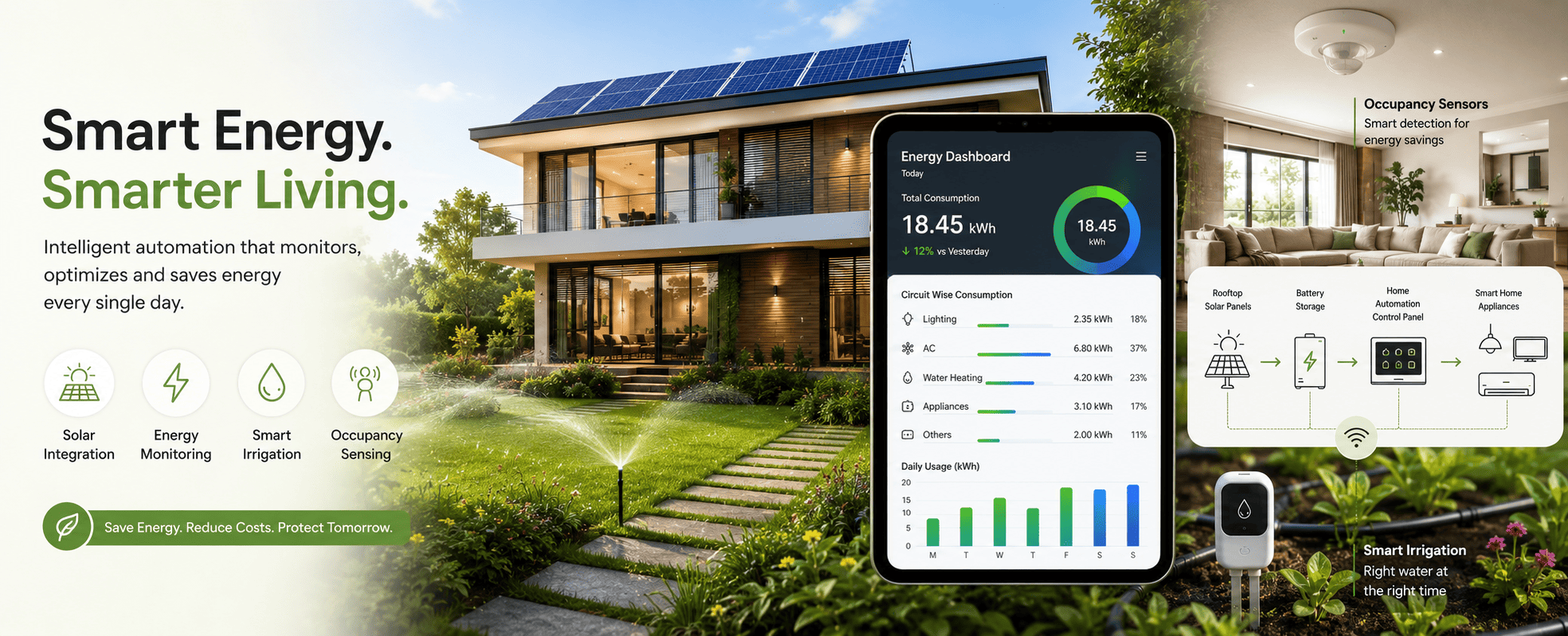
A KNX-based smart home reduces energy and water consumption
by shifting control from passive efficiency measures (like LED bulbs) to active
automation (occupancy-based lighting and climate control) and proactive
monitoring (real-time energy dashboards). The five areas where this makes the
biggest measurable difference are renewable energy integration, scheduling and
remote control, energy and carbon tracking, and smart irrigation.
At Techvault, we design KNX systems for homes across Noida,
Delhi NCR, and 26+ Indian cities where sustainability is increasingly part of
the brief — not as an add-on, but as a core part of how the automation system
is programmed. Here's how each of these five areas works in practice.
How Does Smart Home Automation Move Energy Use from Passive to Proactive?
Most energy-saving advice in India still focuses on passive
efficiency — double-glazed windows, LED lighting, better insulation. These
are useful baseline steps, often aligned with India's Energy Conservation Building Code (ECBC)
and BEE star-rating guidelines. Still, they don't adjust based on how a home is
actually used.
A KNX system adds two further layers on top of this baseline:
Approach |
What It Looks Like |
Example |
Energy Impact |
|
Passive |
One-time infrastructure changes |
LED bulbs, double-glazed windows, and insulation |
Baseline reduction, fixed |
|
Active |
Automated response to conditions |
Occupancy sensors switch off AC/lights in empty rooms;
thermostats adjust by time/occupancy |
Ongoing reduction, scales with usage patterns |
|
Proactive |
Data-driven optimisation |
Energy dashboards show consumption trends, flagging
unusual usage (e.g., AC left on overnight) |
Long-term reduction through behaviour change |
The biggest gains come from combining all three — passive
measures reduce the baseline load, while active and proactive automation reduce
waste on top of that baseline.
How Can KNX Integrate with Solar and Other Renewable Energy Systems?
KNX doesn't generate or store energy itself, but it acts as
the control layer that ties renewable energy sources into the rest of the
home's automation. Most solar inverters and battery storage systems used in
Indian residential projects expose data via Modbus or similar protocols, which
can be bridged into a KNX system through a gateway — allowing the automation
system to factor solar generation and battery state into its scheduling logic.
In practice, this means:
- High-load appliances (water heaters, pool pumps, EV chargers) can be scheduled to run when solar generation is highest
- Battery storage levels can be displayed alongside other home automation data on the same control interface used for lighting and climate
- Excess generation can trigger automated actions — for example, pre-cooling a room before peak grid-tariff hours
This integration is most effective when planned during the initial automation design phase, since it determines how the KNX system's scheduling logic is structured from the start.
How Does Remote Control and Scheduling Reduce Wasted Energy?
This is the most immediately noticeable benefit for most homeowners. Through the same app used for lighting and curtains, a KNX system allows:
- Remote shutoff — lights, AC, or appliances left on accidentally can be switched off from anywhere, rather than running until someone returns home
- Occupancy-based control — motion sensors ensure lighting and climate only run in occupied spaces
- Time-and-condition scheduling — blinds close automatically when room temperature or sunlight exceeds a set threshold, reducing AC load without manual intervention
On a recent project for a 4BHK villa in Greater Noida, we
configured occupancy-based climate zoning across 6 rooms — each zone's AC only
activates when the room is occupied and reverts to a higher setpoint after 15
minutes of vacancy, rather than running continuously through the day.
How Can Homeowners Monitor Their Home's Energy and Carbon Footprint?
A KNX system can integrate smart energy meters at the distribution board level, breaking down consumption by circuit — lighting, AC, water heating, and general power. This data feeds into the same dashboard used for controlling the home, giving homeowners visibility into:
- Daily, weekly, and monthly consumption trends per circuit
- Comparison against previous periods (helping identify when usage patterns change)
- Alerts for unusually high consumption, which often indicate equipment left running or a fault
This monitoring layer doesn't reduce energy use on its own —
its value is in surfacing information that leads to behaviour changes, which is
why we consider it the "proactive" layer in the table above.
How Does Smart Water Management Support Sustainability in Indian Homes?
Water management is increasingly part of sustainability planning for Indian homes, particularly for properties with gardens, landscaping, or larger plots. KNX-integrated irrigation control can:
- Adjust watering schedules based on soil moisture sensor readings rather than fixed timers
- Pause scheduled irrigation automatically when rainfall is detected
- Allow different zones (lawn, garden beds, potted plants) to run on independent schedules based on their specific water needs
For commercial landscaping or larger residential plots, this can represent a meaningful reduction in water usage compared to fixed-schedule sprinkler systems that run regardless of weather conditions.
Conclusion
Sustainability in home automation isn't a single feature —
it's the cumulative effect of passive infrastructure, active automated
responses, and proactive monitoring working together. A KNX system's value here
comes from how these layers are integrated into one home automation platform,
rather than treating energy monitoring, climate control, and irrigation as
separate systems. For homeowners planning a new building automation
project or upgrading lighting
automation, sustainability considerations are worth discussing at the
design stage — retrofitting them later is possible but less efficient.
FAQs
Does adding KNX automation actually reduce electricity bills, or just add convenience?
Both. The convenience features (remote control, scheduling)
directly translate into reduced runtime for AC, lighting, and other loads —
particularly in rooms that are frequently left occupied but unused (lights/AC
left on in empty rooms is one of the most common sources of waste we see in
audits).
Can KNX systems work with the solar panels and inverters already installed in my home?
In most cases, yes — as long as the inverter or battery
system exposes data through a standard protocol like Modbus, which can be
bridged into the KNX system via a gateway. We assess existing equipment
compatibility during the planning phase.
Is smart irrigation only useful for large properties?
No, though the impact scales with garden size. Even smaller
balcony or terrace garden setups benefit from rain-sensing automation that
prevents watering during or immediately after rainfall.
How is "active" automation different from just installing smart switches?
Smart switches alone still require manual triggering or
basic app control. Active automation in a KNX system means the response is
triggered automatically by sensors (occupancy, temperature, light levels)
without the homeowner needing to do anything — that's the key difference in
energy impact.